Orthopedics is a broad field. Even within the same subspecialty, procedures vary widely in complexity, technical demands, and the attention they require. Some are routine and highly reproducible. Others demand patience, judgment, adaptability, and close attention to detail.
To understand this difference, we can compare the work of a tradesman and a craftsman. This is the difference between installing prefabricated kitchen cabinets in a new housing development and restoring custom woodwork in a century-old home. Both require skill, but the first rewards efficiency, standardization, and repetition, while the second depends on interpretation, adaptation, and careful problem-solving.
Orthopedic procedures often fall along a similar spectrum.
The Tradesman: Efficiency Through Repetition
The tradesman is skilled, efficient, and consistent. Think of a plumber, framer, mason, or electrician. These professionals move through work with rhythm and precision. Their success depends on preparation, sequencing, and repetition. The tradesman excels because his technique has been refined and tested over time. Small variations rarely disrupt the process, and experienced helpers can often anticipate each step.
In surgery, many high-volume procedures share these qualities. Rotator cuff repairs, total knees, total hips, and total shoulders require skill and care, but they also benefit from efficiency and reproducibility.
Much like an electrician wiring dozens of similar homes from a blueprint, the surgeon relies on a well-developed process that produces consistent results. The goal is to create a reliable system that allows the surgeon and team to work smoothly, safely, and predictably with a team that knows what to expect.
The Craftsman: Judgment, Adaptation, and Artistry
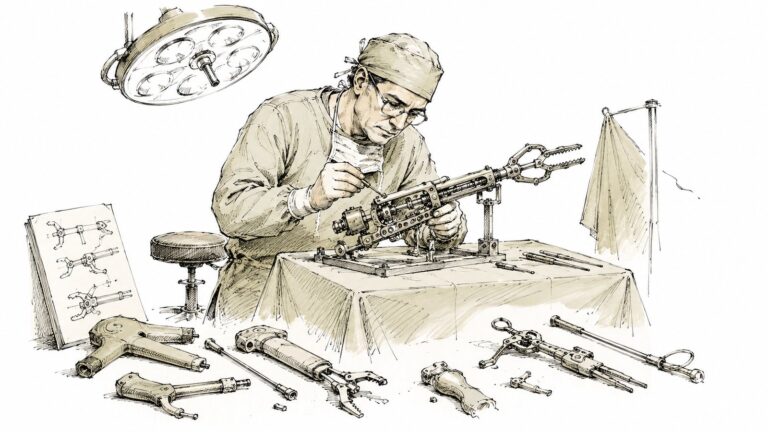
The craftsman operates differently. Like an artist, he responds to the work as it unfolds. The next step is not always obvious because the details emerge in real time. Rather than following a fixed sequence, he adjusts, interprets, and creates.
In surgery, this includes osteotomies, tendon transfers, oncologic procedures, revision surgery, deformity correction, and major reconstruction. Anatomy may be distorted, the margin for error narrower, and key decisions may not become clear until the operation is underway. The surgeon must slow down, reassess, and adapt.
This resembles a master carpenter restoring a historic staircase where no two components are identical and hidden problems are uncovered only after the work begins. Plans may change as new information emerges. Similarly, a revision shoulder arthroplasty may reveal unexpected bone loss, scar tissue, or implant failure patterns that require the surgeon to modify the reconstruction strategy in real time.
Because of the cognitive load involved in making complex decisions in real time, interruptions are especially disruptive. They do more than consume time. They break concentration and interfere with the decision-making process.
Why Surgeons Must Be Both
Like other fields that shift between tradesman efficiency and craftsman thinking, most surgeons must function in both roles. The same surgeon may work like a tradesman during routine procedures and shift into craftsman mode when a case demands deeper analysis and precision.
Problems arise when the wrong mindset is applied: moving too slowly through work that should be streamlined, or too quickly through work that requires deliberate attention.
The Role of Systems in Supporting Both Modes
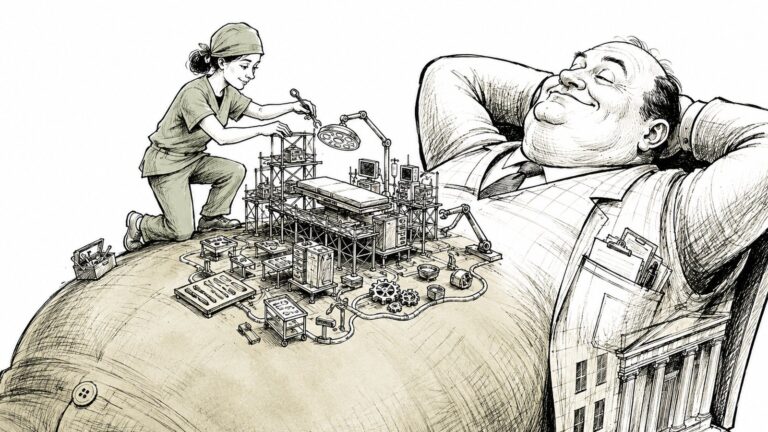
This is where systems matter. When positioning, implants, instruments, documentation, postoperative instructions, and team expectations are organized, the surgeon no longer spends attention on avoidable problems. The system absorbs the routine burden.
For tradesman work, this creates efficiency. The procedure develops a rhythm, the team knows the sequence, and the necessary tools are ready when needed.
For craftsman work, the same system preserves mental bandwidth. The surgeon can focus on anatomy, exposure, fixation strategy, implant position, reconstruction, and judgment. The system cannot make difficult decisions, but it protects the attention needed to make them well.
Surgeons develop these systems whether they realize it or not. This happens by necessity when starting a practice. Technical skill in the OR certainly improves over time, but I suspect some of the bigger gains in efficiency and patient outcomes come from iteratively building systems that support the work being done in the OR. These systems bolster the trade work surgeons do day to day.
This becomes obvious when a surgeon moves to a new hospital or changes jobs. Suddenly, the system is stripped away. The surgeon has to adopt an existing system at the new hospital or rebuild the one they created somewhere else.
The value of the system becomes obvious in these situations. Building from scratch is tedious and difficult. Speed bumps occur, and those speed bumps can affect timeliness of care, team performance, and patient outcomes. Yet the organizations we work for currently own much of the value of these systems by default, because surgeons built them inside those organizations and often leave them behind when they go.
Takeaway: Building the Right Foundation
A tradesman may have every step refined. A craftsman may defer decisions until the moment they are needed. Both, however, rely on the same foundation: the right tools, the right setup, and a team that understands the broader objective.
The system should not force the craftsman to explain every decision prematurely, nor should it slow the tradesman by requiring requests for predictable needs. It should support both approaches, preserving efficiency where possible and protecting focus where necessary.
Great surgeons must be both tradesman and craftsman. Strong systems make that possible by reducing friction in routine work and preserving attention for the moments that require judgment, adaptation, and artistry.
At SurgeonStack, we believe the systems surgeons build around their work should not disappear when they change hospitals, grow their practice, or train new teams. Those systems are part of the surgeon’s value. Our goal is to help surgeons capture, refine, and carry that value forward so they can keep improving both the trade and the craft of surgery.