History often advances when practitioners gain the ability to build the tools their own work demands.
Galileo refined the telescope so he could observe what existing instruments could not reveal. Leeuwenhoek built his own lenses and microscopes, opening an entirely new view of the biological world. In medicine, Charnley transformed hip arthroplasty by developing not just an implant, but an integrated system of materials, instrumentation, surgical technique, and workflow. Ilizarov similarly turned theory into practice by creating his circular external fixator from locally available bicycle spokes, enabling the clinical application of distraction osteogenesis.
Across these examples, a common pattern emerges: the practitioner was not merely a user of technology. They were also the builder of the instrument through which their ideas became reality.
The Loss of Control
Modern physicians have largely lost that relationship with their tools. Surgeons remain somewhat of an exception, with opportunities to collaborate with industry in developing and refining implants and instruments.
Yet the dominant tools of contemporary practice are no longer physical devices. They are software systems: electronic health records, patient portals, documentation templates, scheduling workflows, billing pathways, compliance requirements, and administrative dashboards.
These systems are mandatory, but they were rarely built by the physicians who use them and are often opaque black boxes. They were designed around revenue cycles, regulatory requirements, institutional reporting, and administrative oversight. Over the past 30 years, their role has shifted from serving as databases that support patient care to functioning primarily as reporting and accountability systems that track metrics used to optimize physician throughput.
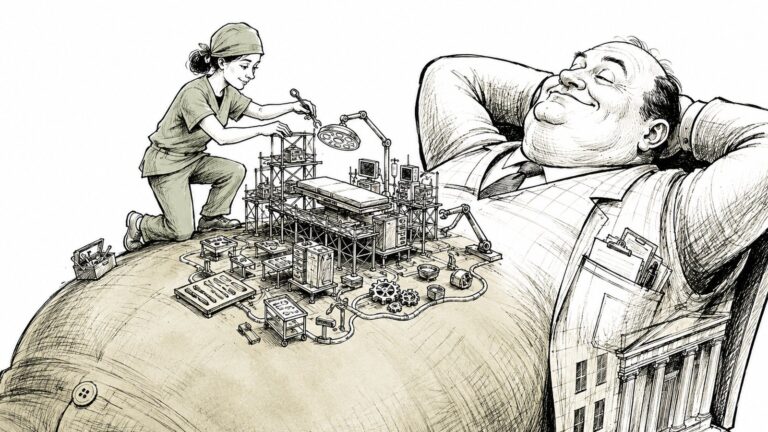
The result is a strange inversion. Physicians trusted to make complex clinical decisions are often forced to practice within software environments they cannot meaningfully shape. Their preferences, protocols, judgment, teaching style, operative workflow, and patient communication habits are squeezed into generic systems designed around someone else’s priorities.
The Opportunity Now
For decades, building software required specialized technical expertise, leaving most physicians dependent on vendors and institutions to define their digital environment. AI changes that equation.
Not by enabling surgeons to manufacture their own implants or grind their own lenses, but by making it increasingly possible for them to create software tools that reflect their own priorities. A surgeon can shape digital workflows around the realities of their practice: their procedures, staff, patients, postoperative protocols, documentation habits, call patterns, preferences, and the questions they answer repeatedly.
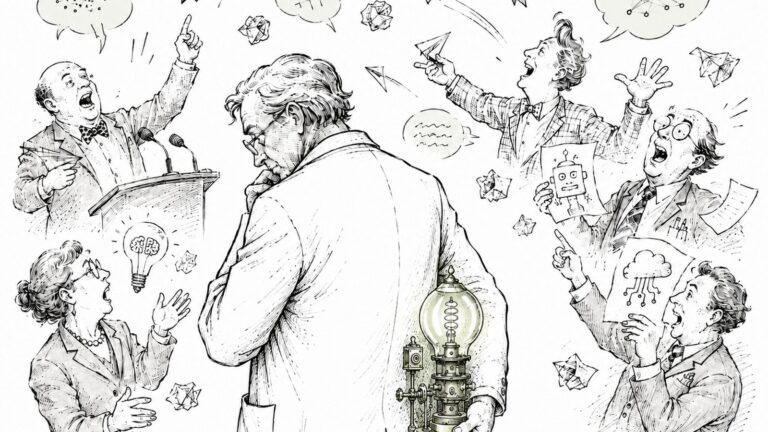
The black box becomes the physician’s workbench.
The opportunity is not simply automation. The opportunity is creation. AI allows physicians to become builders of the digital systems that surround their work. Instead of adapting endlessly to software built for billing departments, compliance boards, and institutional reporting, surgeons can begin creating tools that make clinical work more accurate, more personal, more efficient, and more aligned with the way they actually think.
Today, the physician documents partly for the patient, partly for the next clinician, partly for billing, partly for liability, and partly for compliance. These audiences are collapsed into one burdensome note. AI makes it possible to separate those outputs again: a clinical note for care, a billing artifact for claims, patient instructions for recovery, and staff-facing tasks for execution.
Much of this new accessibility comes from natural-language interfaces. Physicians no longer need deep expertise in coding or software development to participate. They need a clear vision for how a workflow should function, and AI can increasingly help translate that vision into working software.
A Physician-Builder Future
Actually designing workflows that improve practice remains difficult. Previous generations have spent decades negotiating a balance among physicians, billing departments, compliance organizations, and administrators. AI is positioned to reshape that balance. Without physician leadership, the technology may further optimize systems for institutional priorities rather than clinical ones.
This may mark the beginning of a new physician-builder era. The tools are no longer lenses, steel, cement, or carbon fiber. The tools are workflows, interfaces, knowledge systems, patient instructions, protocol engines, and surgeon-specific intelligence. For the first time, physicians may have a realistic path to building those tools themselves.
A Call to Action
AI will reshape medical workflows whether physicians participate or not. The question is whether those workflows will be shaped around the realities of clinical work, or pulled toward the same competing priorities – billing, compliance, reporting, access, liability, and institutional oversight – that have made so many of medicine’s digital systems burdensome.
The EHR is the clearest example, but it is not the only one. Patient portals, scheduling systems, documentation templates, messaging platforms, authorization workflows, and administrative dashboards all shape the way care is delivered. If physicians do not help design the next generation of these tools, they should not be surprised when those tools reflect someone else’s priorities.
For that reason, physicians should begin building now. The starting point does not need to be ambitious. Begin with one small repeatable task: a postoperative question your staff answers every day, a documentation burden that steals time from clinic, a handoff that depends too much on memory, or a patient instruction that never seems to land clearly.
I have previously written that AI raises the floor. Its earliest value may come from the areas physicians understand least, delegate most often, or struggle to supervise consistently. These are the places where better tools can improve not only the physician’s day, but the performance of the entire team.
Do not get too caught up in the software. Focus instead on the workflows and relationships that support your practice. Look for opportunities to empower the people and systems around you to make better decisions and operate more effectively on your behalf.
No single builder will determine how medical workflows evolve or who benefits from those changes. But if physicians participate broadly, the profession has a chance to shape this technology around clinical work rather than simply adapt to another generation of administrative tools.
If physicians do not build, AI will still be built into medicine. It will simply be built by others, for other goals. The opportunity exists only if physicians choose to build.