Adapted from a presentation at the 2026 Hawkins Society meeting.
This commentary is adapted from a presentation I gave at the 2026 Hawkins Society meeting on surgical systems, artificial intelligence, and physician ownership of clinical context.
Opening: My path into AI
I first got involved with AI through two orthopedic research papers published in 2024 and 2025. In those studies, we evaluated ChatGPT on orthopedic training-style questions. The early model performed roughly at the level of a first-year resident. The next major iteration, GPT-4o, performed closer to the level of a senior resident or chief resident.
That was impressive, but it was not enough. Around one-third of the answers were still wrong, and the concerning part was not just that the model was wrong, it was that it was confidently wrong. It could reason incorrectly in a way that sounded plausible.
So, the early question was: Can we trust this? At that stage, the answer was: not blindly, and certainly not as a standalone surgical decision-making system.
Over the last 12 to 18 months, the question has shifted. It is no longer simply, ‘Does AI work?’ Most of us have now had the experience of asking AI something in a field where we are supposed to be the expert, and it still teaches us something useful. That changes the question from ‘Can we trust it?’ to ‘How does AI work for me? Where does it fit into my workflow? What should it do, and what should it not do?’
The path that led me to exploring this topic is unusual. Before medicine, I worked as an electrician in Texas. I worked on projects like the Formula One track in Austin, McLane Stadium in Waco, and the Dell Medical School.
One of the practical problems we had was bending large pipe accurately. Four-inch conduit had to be bent with a hydraulic pipe bender, often off-site. If your measurements were wrong, you wasted time, material, and labor.
So I wrote a small piece of software to do the trigonometry: the bend angles, the measurements, and the distance between bends. That was my first experience using software not as a toy, but as a productivity tool.
The pattern repeated
Over the years, I kept building small tools like that. I wrote code to analyze research data, choose statistical tests, visualize financial and business topics, model CMS payment rules, automate parts of case logging, and understand operative workflows.
These were usually small utilitarian projects: 50 lines, 200 lines—just enough to solve one specific problem. I did not think of myself as anything close to an expert on software, but I knew that I could use software as a tool to get work done.
Then AI changed the scale of what was possible. Over the last year, I started watching how AI was transforming software development, and because I was somewhat outside that world, I could see the pattern clearly.
The front-line work shifted. Instead of starting from zero, people were using AI to create a first draft, scaffold the structure, generate options, and accelerate the early heavy lifting. Execution costs are also collapsing: it is now cheaper to test multiple ideas than to commit everything to one idea. Historically, if you had one good idea, you had to invest a lot of time before you knew whether it worked. Now, you can prototype five versions, compare them, throw away the weak ones, and keep the best.
Even more important is this realization: AI raises the floor more than it raises the ceiling. Experts may not always feel the biggest benefit immediately, because they can already produce high-quality work quickly. But for someone below expert level, AI can dramatically increase throughput. It helps them get closer to the expert’s level of output.
That shift changed my own work. My software side projects went from 50- or 200-line scripts to systems with tens of thousands or hundreds of thousands of lines of code, including backend logic, front-end interfaces, clinical workflows, payment modeling, operative note structures, preference cards, and case-logging tools.
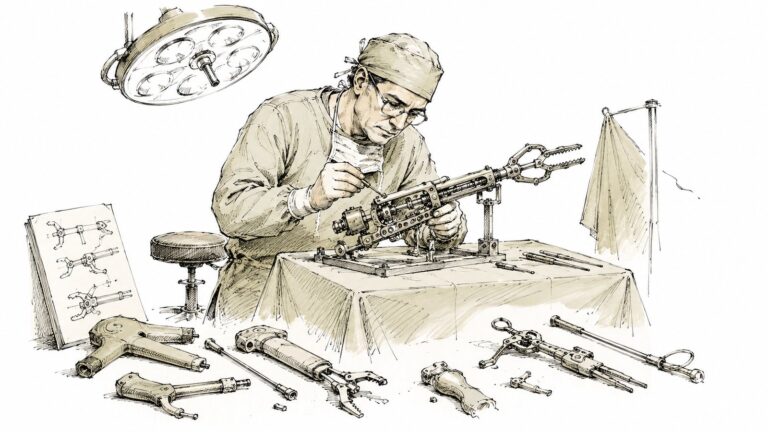
That eventually became an attempt to capture a surgeon’s surgical system around the operating room in one place.
ASIDE: The idea is that a surgeon’s workflows, preferences, materials, techniques, notes, billing logic, and operative context should not be scattered across hospitals, vendors, device companies, EMRs, and personal memory. There should be a surgeon-owned layer that preserves that context.
AI did not make work easier — it made more work possible
When I first started using AI seriously, I thought the point was that it would make life easier. I thought it would give me more time back.
That is not really what happened.
It did not make the work trivial. It made more work possible. In some ways, I worked more, not less, because I now had tools that allowed me to execute ideas I previously would not have even attempted.
This is a recurring pattern in history. Productivity tools do not usually shorten the workday. They increase output expectations.
The cotton gin is a useful example. If a worker could clean one pound of cotton by hand in a day, and the cotton gin allowed fifty pounds per day, people did not work 30 minutes in the morning and go home. Output increased. The gin made cotton processing dramatically more efficient, which increased the profitability of cotton, expanded acreage, and ultimately increased the demand for labor to plant and pick it. Demand expanded to meet the new productive capacity.
We saw a similar pattern with the EMR. Digital documentation did not simply shrink the note or reduce the documentation burden. In many settings, it expanded what could be captured, audited, searched, copied forward, and demanded from the clinical encounter. The result was not just better access to information, but also longer notes, more structured data entry, more after-hours work, and a higher administrative burden for physicians.
What this means for physicians
So the question is: what happens when AI enters medicine?
I do not think the main effect will be that physicians work less. I think the main effect will be that expectations rise.
What that looks like in practice:
- More documentation
- More structured data capture
- More administrative throughput
- More patient messages
- More compliance monitoring
- More downstream use of the clinical encounter
AI will make it easier to transform natural language into structured data. That means things that used to be too difficult to capture may become expected. The average clinician may be pushed toward elite-level documentation—not because it is clinically necessary in every case, but because the system can now demand it.
AI scribes are one of the earliest AI use cases entering medical workflows. Optimistic physicians see them as a way to reduce documentation burden and restore the patient-physician interaction at the center of healthcare. That is possible. But shorter patient visits were never caused by documentation alone. They are also shaped by scheduling templates, reimbursement models, staffing constraints, inbox burden, throughput expectations, and institutional priorities.
NOTE: So if AI reduces the time required to document a visit, the key question becomes: where does that freed capacity go?
It could become longer visits and better patient relationships. Or it could become more patients per day, faster revenue cycles, more structured data capture, more PROM collection, and tighter compliance monitoring. Which future we get will depend less on the AI model itself and more on who designs the workflow around it.
The central risk
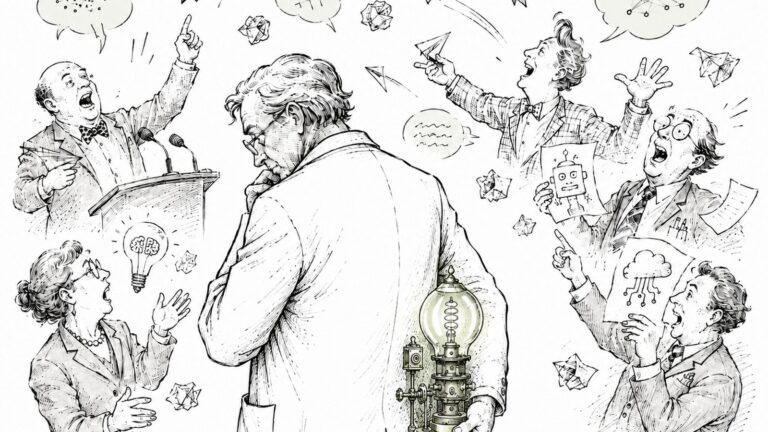
The danger is that physicians become technicians operating inside systems they do not control.
AI accuracy depends heavily on context. The model is only as useful as the information it has: the patient history, the surgical plan, the surgeon’s preferences, the implants, the technique, the constraints, the clinical judgment, and the reason behind the decision.
Physicians create that context. But over the last several decades, much of it has become siloed inside systems we do not own: hospitals, EMRs, vendors, billing platforms, scheduling systems, and industry tools. Our clinical data, operative workflows, documentation patterns, scheduling systems, billing systems, and practice patterns often live inside hospitals, EMRs, vendors, and industry platforms.
Closing argument
So we have to ask: who will use that context, and for what purpose?
- Will it be used to help physicians take better care of patients?
- To improve the patient experience?
- To make clinical work more humane and more effective?
- Or will it be used primarily for revenue cycle, compliance surveillance, productivity pressure, sales, and administrative leverage?
My argument is not that physicians should reject AI. It is the opposite. Physicians need to understand AI, use it, and help shape it. But to do that, we need ownership of our clinical and surgical context. We need systems that reflect how we actually think, operate, document, and care for patients.
If physicians do not help build and control those systems, then someone else will. And those systems will still shape our work. AI makes it possible for physicians to build tools that were previously out of reach. That means we have a rare opportunity: not just to adapt to the future of medicine, but to help design it.